Under-Eye Hollows Treatment in Marylebone, London
Tear-trough treatment is one of the most technically demanding injectable procedures. Only a flexible filler and cannula technique in experienced hands.
Book Consultation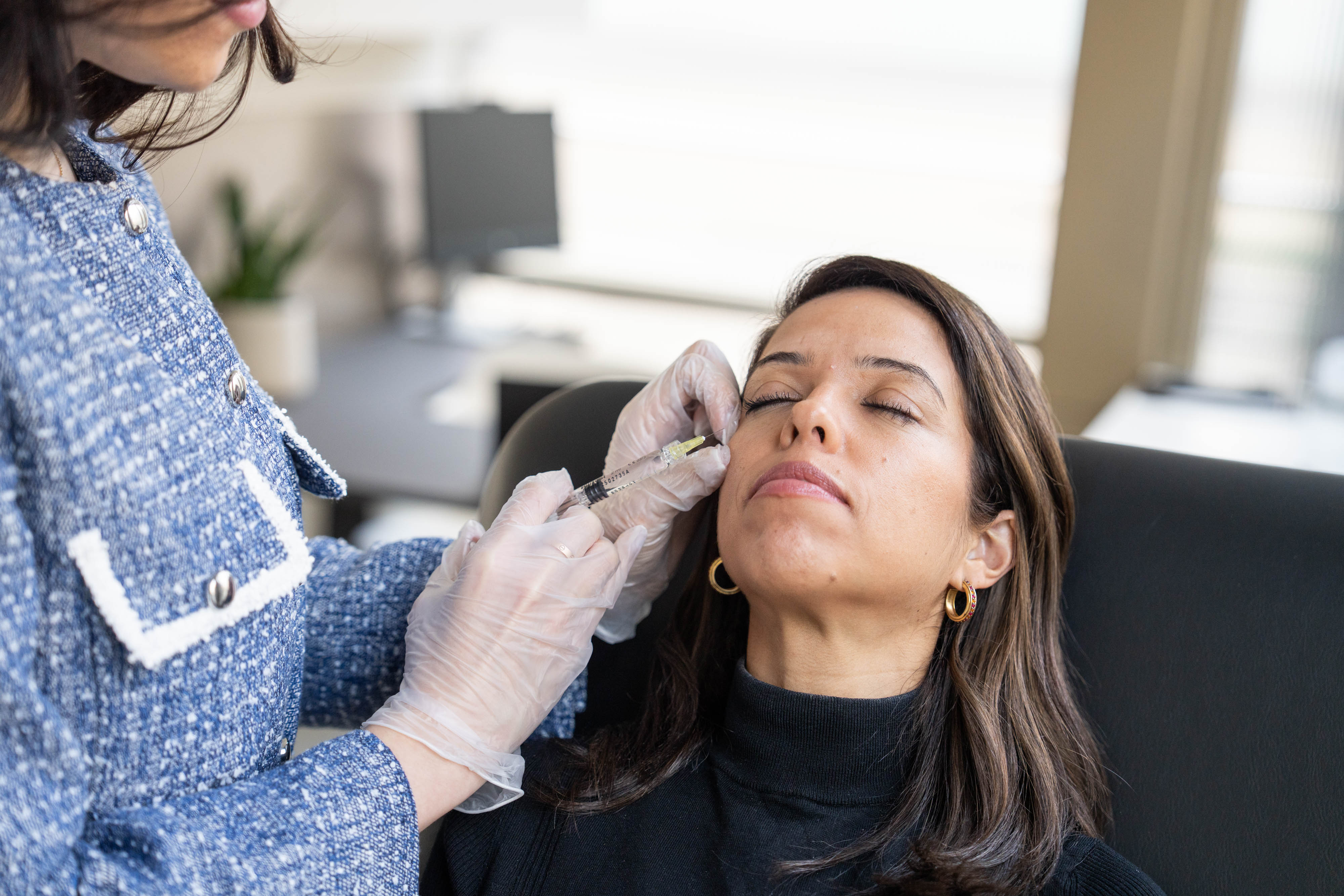
Under-eye hollows (tear-trough depressions) form where the cheekbone meets the under-eye area and are caused by a combination of bony anatomy, loss of mid-face volume, thinning skin, and in some people protrusion of the orbital fat pads. The result is a tired, hollow, or "shadowed" appearance that persists regardless of how well you sleep. Concealer masks it temporarily but can accentuate texture; skincare does not reach the depth of the problem; the only treatment that reliably addresses the actual anatomical issue is a carefully placed flexible hyaluronic acid filler — and even that is not suitable for everyone.
Dr Valentina uses Restylane Defyne for tear-trough treatment exclusively, because it is specifically engineered to flex with movement and resist water absorption (minimising the "bluish" tyndall effect and puffiness that can result from standard filler in thin under-eye skin). All tear-trough work is performed with blunt-tipped cannula technique, never a needle, to minimise the risk of bruising and vascular injury in this delicate area.
What drives this concern
- Loss of midface volume from mid-30s accentuates the bony orbital rim
- Thin under-eye skin allows underlying anatomy to show through
- Genetic pronounced orbital rim anatomy (some people have it from their teens)
- Protruding orbital fat pads — worsened by rest loss or allergies
- Photoaging and chronic squinting worsen peri-orbital skin thinning
Treatment options for under-eye hollows
Dermal Fillers
From £350The primary treatment for tear-trough hollows. Restylane Defyne via cannula in a deep supraperiosteal plane. 1ml total across both sides is standard. Results last 12 to 15 months.
See treatment detail →Skin Rejuvenation
From £200Under-eye skin quality — fine lines, crepiness, mild pigmentation — responds to a gentle course of microneedling or a targeted peel. Often used alongside filler.
See treatment detail →Profhilo & Biostimulators
From £550 (starter course)Profhilo improves overall skin hydration and elasticity; peri-orbital quality often benefits as a side effect of facial Profhilo treatment.
See treatment detail →FAQ
Common
questions
Am I a candidate for tear-trough filler?
Not everyone is. Ideal candidates have a bony or volume-loss hollow with good-quality under-eye skin. Patients with prominent fat pad protrusion (visible bags that bulge forward rather than hollow dips) are generally better served by lower blepharoplasty (surgical fat removal or repositioning) rather than filler. The consultation includes a structured assessment — Dr Valentina will honestly tell you if you are not a candidate.
Will tear-trough filler cause puffiness or a blue tinge?
These complications — mostly seen with the wrong filler (too hydrophilic) placed too superficially — are largely avoided by product choice and technique. Restylane Defyne is less hydrophilic than many alternatives, and deep supraperiosteal placement via cannula puts the product below the thin under-eye skin where a tyndall effect cannot show through. If it ever happens, hyaluronidase dissolves it within 48 hours.
How long does tear-trough filler last?
Tear-trough filler typically lasts 12 to 15 months. Some patients report visible product for up to 2 years in this area because the tissue is relatively static — unlike lips, which move constantly and break HA down faster. Maintenance is typically an annual top-up with 0.5ml rather than a full 1ml refresh.
How much does tear-trough treatment cost?
£550 for 1ml of Restylane Defyne treating both sides, including the 2-week review. If only one side needs treatment (rare — most tear-trough issues are bilateral), 0.5ml is £350. Hyaluronidase dissolution, if ever needed, is £250 per session.
Related Concerns


Get Started
Ready to begin?
Book today.
Dr Valentina Aesthetics • 1 Orchard Street, London W1H 6HJ
Book a SessionAppointments typically available within 1–2 weeks